Your IT budget has a number. Your technology risk should too.
Most CFOs inherit an IT environment they did not build and cannot fully evaluate. The infrastructure runs, the bills get paid, and the details stay buried inside a department or vendor relationship that reports in a language finance does not speak.
Then something forces the conversation — a cyber insurance renewal that doubled in cost, a compliance audit with findings that need capital, a board question about ransomware exposure, or a vendor contract that quietly locked in a six-figure commitment nobody reviewed.
The gap is not awareness. CFOs know IT risk exists. The gap is a framework for quantifying it in terms the business already uses — probability, financial exposure, cost of controls, and return on risk reduction.
This playbook closes that gap.
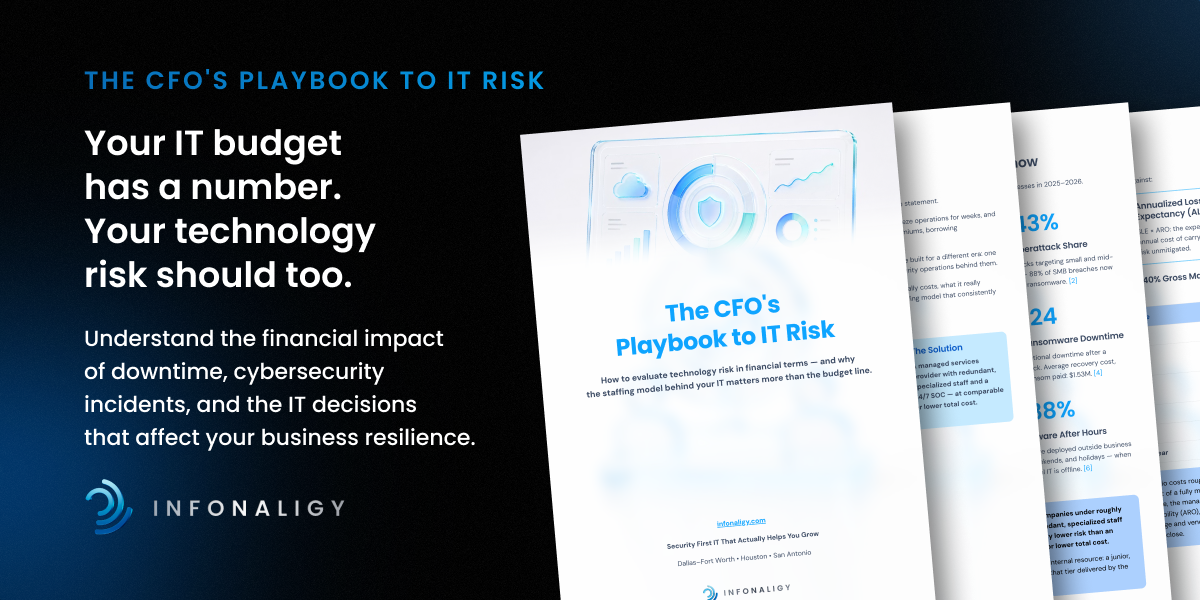
The numbers that define the financial landscape of IT risk
$10.22M average U.S. data breach cost
The highest of any country in 2025. The global average is $4.44M. Small and mid-sized businesses are not exempt — 43% of all cyberattacks target SMBs.
$10K+ cost per hour of downtime
78% of SMBs report a single hour of downtime costs more than $10,000. Ranges from $5K to $50K per hour depending on industry.
24 days of average ransomware downtime
Average operational downtime after a ransomware attack. Average recovery cost, excluding ransom paid: $1.53M. 88% of ransomware deploys outside business hours.
The question is not whether your organization faces IT risk. The question is whether you can quantify it, price it, and make defensible decisions about it — the same way you handle every other category of business risk.
When this playbook becomes essential
There is a pattern. The CFO who picks up this playbook is usually facing one of these situations — sometimes two or three at once:
- Cyber insurance renewal sticker shock — premiums increased 40–60%, the questionnaire tripled in length, and your broker is asking for documentation you do not have
- A peer company was breached — and the CEO or board is now asking what would happen here, and you cannot answer with confidence
- IT spend is climbing but outcomes are not — you are spending more every year on technology and security, but you cannot articulate what you are getting for it
- Compliance deadlines are approaching — HIPAA audits, SOC 2 readiness, CMMC certification, or a customer requiring a vendor risk assessment, and you need to understand the financial commitment
- You are evaluating your IT provider — the current MSP or internal team may be competent, but you have no way to independently verify whether the risk posture they describe is real
- M&A due diligence — you are acquiring or merging with a company and need to assess their IT risk exposure before closing
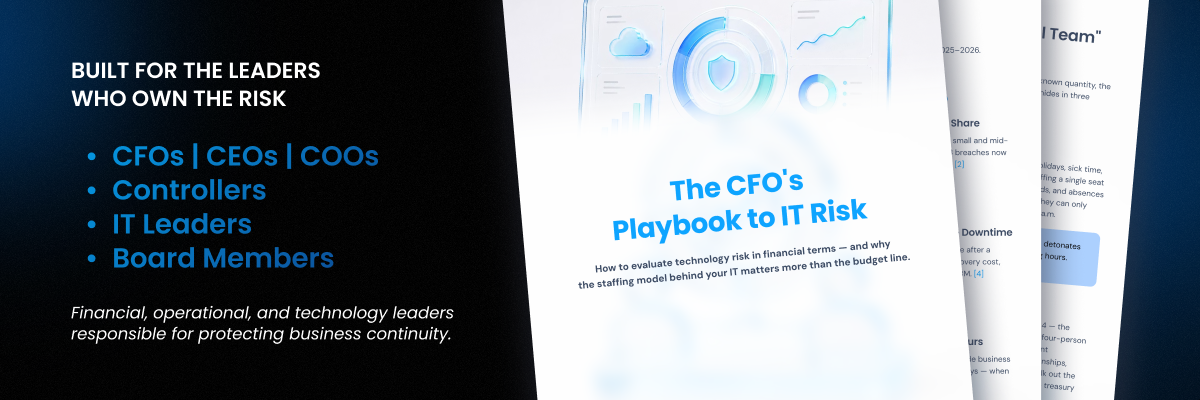
What you are actually getting
This is a working document — not a whitepaper you read once and shelve. Each section is designed to be used during real decisions, real budget cycles, and real conversations with insurers, auditors, and leadership.
IT Risk Quantification Model
A step-by-step method for translating technical risks into financial terms. Covers threat probability estimation, asset valuation, single loss expectancy, annualized loss expectancy, and cost-of-control analysis. No security background required — built for finance professionals.
The Hidden Cost of the Small Internal IT Team
A detailed breakdown of why the one-to-four-person internal IT model leaves most mid-sized companies exposed — coverage gaps, key-person risk, and what the fully loaded cost actually buys versus a managed services model with a 24/7 SOC.
IT Risk Scorecard
A structured evaluation across ten domains — governance, 24/7 coverage, key-person resilience, identity security, endpoint detection, backup and recoverability, incident readiness, patch discipline, vendor risk, and financial quantification. Each domain is weighted by its contribution to disruption likelihood and financial severity.
Expected Loss from Downtime Calculator
Model your own downtime exposure using gross profit — the number your P&L actually loses when operations stop. Run it per scenario (ransomware, outage, vendor failure) and compare your combined annualized loss expectancy against the cost of the controls that would prevent it.
10 Questions to Ask Any MSP
The questions that separate a genuine managed services partner from a vendor that is simply reselling licenses. Covers SOC operations, incident response SLAs, staffing depth, reporting, insurance support, and offboarding.
One-Page Quarterly Board Report
A presentation-ready template for communicating IT risk to non-technical stakeholders. Includes risk posture summary, top scenarios in financial terms, and decisions required — designed to survive a board meeting.
What changes when you treat IT risk like any other business risk
IT spend stops being a black box
You get a framework for decomposing IT costs into categories that map to business outcomes — not vendor invoices. Every dollar is tied to what it protects, enables, or exposes.
Cyber insurance becomes a negotiation, not a surprise
When you can document your control posture, incident response capability, and risk treatment decisions, underwriters respond with better terms. You stop reacting to questionnaires and start driving the conversation.
Board and leadership conversations get concrete
Instead of vague updates about "improving security posture," you present risk in dollars — annualized loss expectancy, cost of controls versus cost of exposure, and clear thresholds for acceptable risk.
Compliance shifts from reactive to strategic
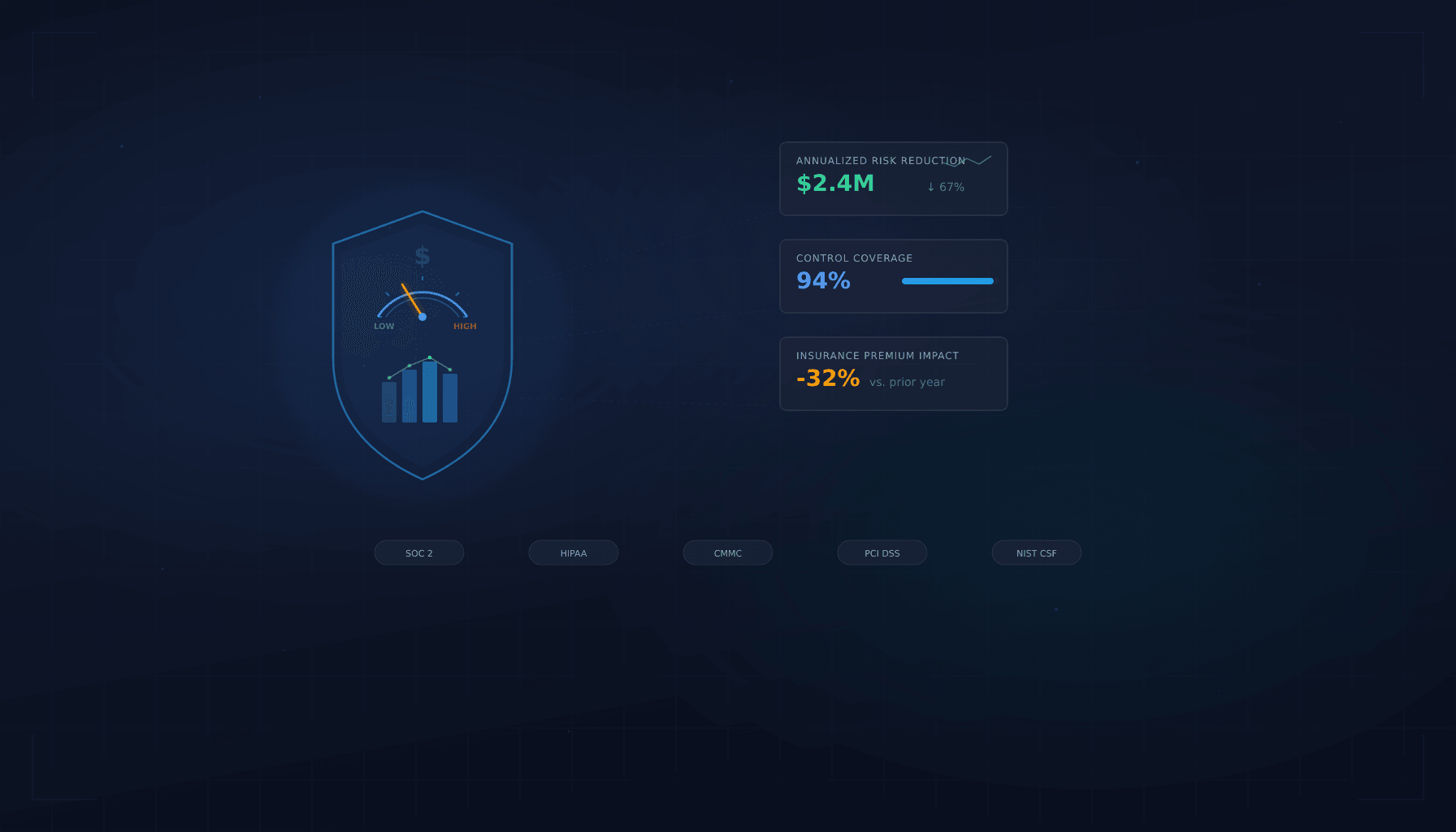
HIPAA, SOC 2, CMMC, PCI DSS — each framework has a cost. This playbook helps you evaluate which controls deliver compliance coverage and risk reduction simultaneously, so you stop paying twice.
How Infonaligy approaches this differently
Most IT providers hand you a technical assessment and a quote. You get a list of vulnerabilities scored on a scale you did not build, recommendations that all happen to require their products, and a price tag with no business context.
We start with the financial conversation. What does a breach actually cost your organization — not the industry average, but yours? What does downtime cost per hour? What is the real financial exposure from your current compliance gaps? What is your cyber insurance actually covering, and what is excluded?
From there, every recommendation is tied to a number — the cost of the control, the risk it reduces, and the timeline for implementation. You get a risk register that speaks the language of finance, not a vulnerability scan that speaks the language of penetration testers.
This is the same discipline our leadership team applied in Fortune 50 environments — adapted for organizations with 50 to 250 employees that need the rigor without the overhead.
Talk to our team about your IT risk posture →
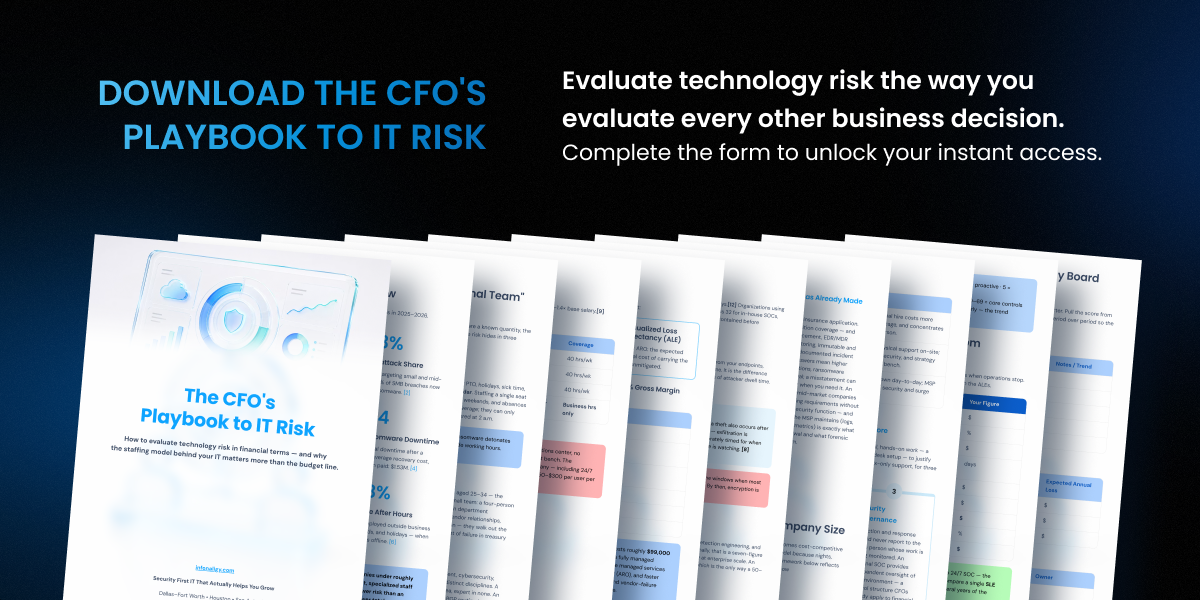
Download the CFO’s Playbook to IT Risk
Evaluate technology risk the way you evaluate every other business decision. Complete the form to unlock your instant access.
Frequently Asked Questions
This playbook is built for CFOs, CEOs, COOs, controllers, IT leaders, and board members — the people responsible for protecting business continuity and making financial decisions about technology risk. No security background is required. Every framework, scorecard, and worksheet is written in the language of finance.
No. The playbook presents industry data, financial models, and worksheets you can use regardless of your current IT model. It does walk through the staffing economics of internal teams versus managed services providers with a SOC — because the cost comparison is central to the risk discussion — but the frameworks and tools work whether you manage IT internally, use an MSP, or run a hybrid model.
The playbook is especially useful in that case. Section 1 breaks down the hidden risks in the small internal team model — coverage gaps, key-person concentration risk, and the fully loaded cost analysis most organizations have never run. It helps you evaluate whether your current staffing model matches your actual risk exposure, and what a hybrid or co-managed model would look like at your company size.
Cybersecurity risk is one component of IT risk, but IT risk is broader. It includes operational downtime from any cause, key-person dependency, vendor failure, compliance gaps, insurance coverage misalignment, and the financial exposure created by how your technology environment is staffed and managed. This playbook addresses all of those dimensions in financial terms.
The scorecard evaluates your organization across ten weighted domains: governance and accountability, 24/7 coverage and monitoring, key-person resilience, identity security, endpoint detection and response, backup and recoverability, incident readiness, patch and change discipline, vendor and third-party risk, and financial quantification. Each domain scores on a 0–5 maturity scale, and the weighted total gives you a risk posture score out of 100.
The playbook includes a worksheet that walks you through it step by step. You start with your annual revenue and gross margin to calculate gross profit per day, then model the expected duration and severity of a disruption scenario. Multiply by the annual probability of that scenario occurring, and you get your annualized loss expectancy — the number you can compare directly against the cost of the controls that would prevent it.
Yes — that is one of its primary use cases. Section 8 includes a one-page quarterly board report template designed specifically for presenting IT risk to non-technical stakeholders. The entire playbook is written to be read and used by business leaders, not IT specialists.
The playbook is built around the economics and risk profile of mid-sized businesses with 50 to 500 employees. The staffing models, cost comparisons, and risk scenarios are calibrated for organizations at that scale — where the internal IT team is typically one to four people and the gap between coverage and exposure is most acute.
Related Resources
Board and Leadership Risk Report Template
A presentation-ready template for communicating IT risk to non-technical stakeholders with executive summaries, risk heat maps, and budget justifications.
View resource →IT Risk Quantification Model
A step-by-step framework for translating technical IT risks into financial terms that CFOs, boards, and insurers understand.
View resource →IT Spend Efficiency Worksheet
Map every IT and security dollar to the risk it mitigates, the compliance requirement it satisfies, or the business function it enables.
View resource →Ready to Get Started?
Contact us today for a complimentary assessment valued at up to $25,000.