PHP2Shell Response: Start the Investigation Before Disclosure
PHP2Shell attempts appeared before disclosure. Learn which PHP versions are fixed, when investigations should begin, and how to reduce patch time.
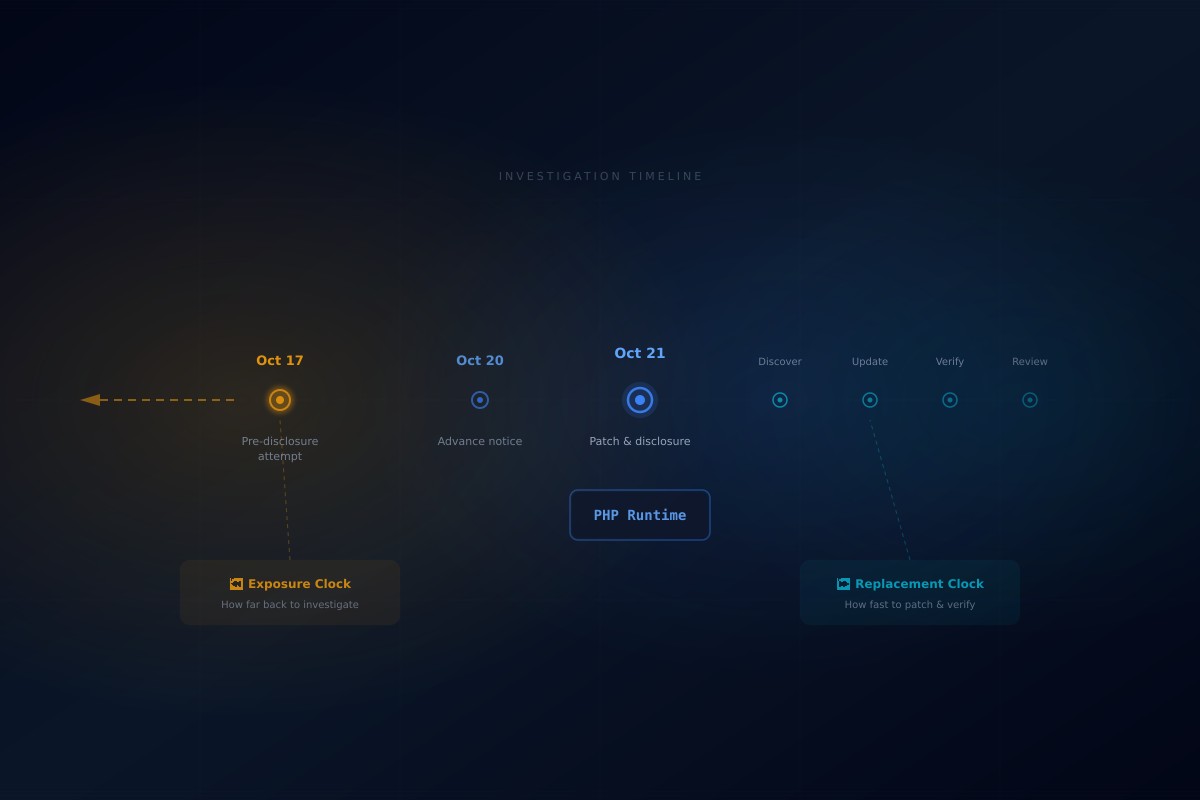
October 21 is the patch date.
It is not the safest beginning for the investigation.
The PHP project disclosed two critical vulnerabilities—CVE-2026-109618 and CVE-2026-109619—that can allow unauthenticated remote code execution. But AWS found an apparent exploitation attempt in its honeypot telemetry dated October 17, four days before the public announcement.
AWS has not established that the attempt would have succeeded against a production system. That evidence boundary matters. So does the operational lesson:
When credible activity predates disclosure, the incident timeline must move backward with it.
Organizations running public PHP services should update immediately and review available evidence from at least October 17.
The timeline that changes the response
October 17
AWS observed an apparent PHP2Shell exploitation attempt
Investigations beginning on disclosure day may miss relevant activity
October 20
PHP issued advance notice of a critical security release
Prepared organizations could begin inventory and change planning
October 21
Fixed PHP releases and vulnerability details became public
The complete remediation became available
After disclosure
Broader attempts appeared in AWS telemetry
Public technical information increased the likelihood of continued probing
AWS observed attempts, not confirmed compromise of every exposed server. Still, beginning the review on October 21 would create an avoidable four-day blind spot.
Organizations should move the starting point earlier if their own logs reveal suspicious activity before October 17.
Which PHP versions contain the fixes?
The PHP project’s 2026 release archive identifies these corrected versions:
| PHP branch | Fixed release |
|---|---|
| PHP 8.5 | 8.5.12 |
| PHP 8.4 | 8.4.27 |
| PHP 8.3 | 8.3.36 |
| PHP 8.2 | 8.2.35 |
PHP says no available configuration mitigation covers every vulnerable path. Updating is the only complete remediation.
PHP 8.2 also reaches end of life on December 31, 2026. Installing 8.2.35 addresses the immediate vulnerabilities, but organizations remaining on that branch still need a near-term migration plan.
Older branches require special attention. Some operating-system or commercial support providers may issue backported corrections, but administrators must verify that protection with the responsible vendor.
Your website inventory may stop one layer too early
A company may know that it operates WordPress, Drupal, Laravel, or a customer portal without knowing which PHP runtime serves it.
That runtime might live inside:
Updating the application does not necessarily update PHP. Updating a package manifest also does not prove that every worker, container, or server restarted with the corrected version.
The useful inventory question is not only, “Which websites use PHP?”
It is:
Which running service executes each request, which PHP branch does it use, and who can replace it today?
PHP2Shell creates two separate clocks
The exposure clock
This clock determines how far back the investigation must reach.
For PHP2Shell, teams should begin no later than October 17 and review web requests, process execution, file changes, outbound connections, authentication events, container activity, and persistence.
Amazon Threat Intelligence recommends examining suspicious multipart requests involving PHP_SESSION_UPLOAD_PROGRESS. That is a useful lead, but it should not become the entire detection strategy. Attackers can change payloads, infrastructure, and request patterns.
The replacement clock
This clock measures how quickly a team can identify the runtime, test the correction, restart the service, validate the application, and prove that the fixed version is running.
A nominal 30-day vulnerability SLA is not enough for an internet-facing runtime under credible exploitation pressure. Critical systems need an hours-scale path for emergency replacement.
That requires known owners, tested rollback plans, current deployment documentation, retained logs, and a way to validate the business application after the runtime changes.
What should happen now?
Identify every internet-facing PHP runtime, including development, staging, acquired-company, and dormant environments.
Deploy a corrected release—or a vendor-confirmed backport—and verify it from the running service. Do not rely only on a completed automation job.
Review evidence beginning October 17 or earlier. Preserve web, application, process, endpoint, container, cloud, and network telemetry before it expires.
Where a runtime cannot be corrected quickly, isolate or replace it. PHP's partial mitigations may reduce exposure during an emergency change, but they do not create a complete long-term defense.
The Infonaligy perspective
The most useful response metric is not the number of days required to close a vulnerability ticket. It is the time required to find the affected runtime, assign an accountable owner, deploy a verified replacement, and reconstruct the credible exposure window.
Infonaligy’s SOC Services, Managed IT, and Cloud Infrastructure teams help organizations connect asset ownership, monitoring, application support, and emergency change processes before the next critical runtime vulnerability arrives.
If your organization cannot quickly identify which runtime serves each public application, this incident is a reason to close that visibility gap now. Contact Infonaligy at 800-985-1365.
Frequently asked questions
The PHP project identifies 8.5.12, 8.4.27, 8.3.36, and 8.2.35 as corrected releases.
Not automatically. Exposure depends on the PHP runtime and architecture serving the site. WordPress administrators should verify the running PHP version rather than assuming a WordPress update corrected it.
AWS observed an apparent exploitation attempt beginning October 17. It did not establish that the attempt successfully compromised a production system.
No. PHP says the available mitigations are incomplete and that updating is the only complete remediation.