Cloudflare Clairic: Stop Using Generative AI for Every Step
Cloudflare Clairic shows how typed extraction can separate facts, decisions, calculations, and language in business automation.
A customer emails about a damaged shipment.
One model reads the message, finds the order number, calculates the amount paid, interprets the return policy, chooses a resolution, and writes the reply.
The response sounds polished.
Now the team must determine whether the model misread the invoice, failed at arithmetic, misunderstood the policy, or invented a detail while composing the message.
Cloudflare’s new Clairic preview points toward a better design: give facts, calculations, decisions, and language to components built for those particular jobs.
What Clairic does differently
Cloudflare describes Clairic as an extraction model rather than a conventional generative language model.
A request defines the information the workflow needs. Clairic returns typed values such as text, numbers, dates, durations, lists, estimates, or forecasts. Depending on the field, the response may also include:
Source span
Where the information appeared in the input
Confidence score
A numerical confidence level for the extracted value
Absence probability
The probability that the value is absent from the input
Estimate interval
A median and bounded interval for an estimate
Null result
Returned when the requested information cannot be established
Typed output solves one practical problem: a date arrives as a date, not a sentence that downstream software must interpret.
It does not solve correctness automatically.
Cloudflare explicitly cautions that a well-formed response can still be wrong. Confidence, probability, and intervals are signals for workflow routing—not certificates of truth.
Follow one request through a better workflow
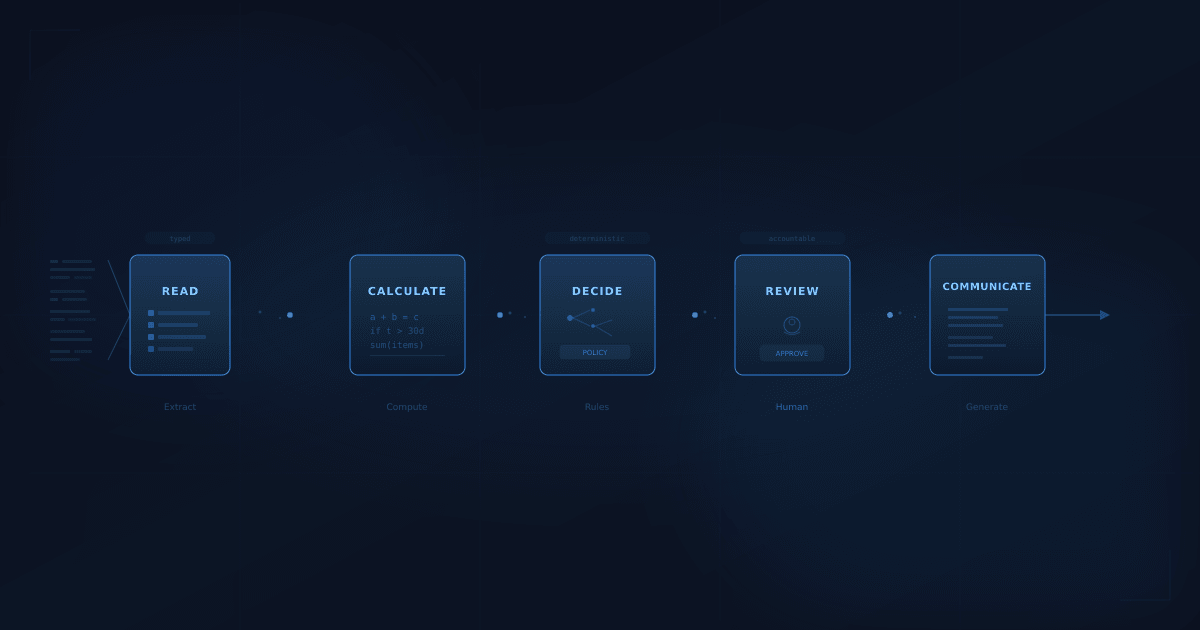
Return to the damaged-shipment email. Instead of giving one generative model the entire job, separate the work.
Read
Extraction model, parser, OCR, or application API
Find the order, dates, amount, product, and reported damage
Calculate
Deterministic code
Add totals, calculate elapsed time, or compare monetary thresholds
Decide
Approved business rules or bounded decision model
Determine the allowed resolution
Review
Human approver when required
Handle ambiguity, sensitive actions, or exceptions
Communicate
Generative model or template
Explain the approved decision clearly and appropriately
This structure does more than improve accuracy.
It makes mistakes diagnosable.
If the order amount is wrong, the team can inspect the extracted source span. If the eligibility decision is wrong, it can review the policy rule. If the customer message introduces an unsupported promise, it can correct the communication stage without rebuilding the entire workflow.
The generative model receives only the facts and decision it needs. It does not need unrestricted access to the original document, every account field, or the complete business policy.
Separating extraction, calculation, and decision-making is the foundation of governed automation. Infonaligy helps organizations design workflows where each component does what it does best.
Confidence should control the route—not declare the truth
A confidence score becomes useful only when paired with the consequence of being wrong.
The same score should not authorize every type of action.
| Information or action | Appropriate response |
|---|---|
| Low-impact internal categorization | Allow automation after validation demonstrates acceptable accuracy |
| Missing or contradictory information | Stop and request clarification |
| Customer identity or bank information | Require stronger validation |
| Payroll, medical, or contractual data | Route uncertain results for human review |
| External payment, deletion, or account change | Require approval regardless of model confidence |
Organizations should establish thresholds separately for each field and action. A generic rule such as “automate anything above 90%” is not meaningful until the score has been tested against representative data.
That testing must examine false acceptance, false rejection, review volume, unfamiliar formats, and the business cost of an incorrect action.
What the preview can—and cannot—prove
Clairic is available as an early preview endpoint on Workers AI. Cloudflare says an open-weight release is planned, but the weights were not available at publication time.
The company also identifies several limitations:
Longer chains of arithmetic should remain in code.
Aggregation across many table rows remains difficult.
Estimates need evidence in the input.
Calibration may weaken on unfamiliar data.
Forecasting is basic and should not replace specialized forecasting systems for critical long-range predictions.
Cloudflare reports lower cost and latency for a vendor-designed cascade using extraction, decision, and generative components. Those results are useful as a design example—not an independent performance guarantee.
Organizations should reproduce the comparison with their own documents, errors, infrastructure, and review requirements.
A useful pilot begins with failure cases
Choose a narrow workflow whose current results can be reviewed: invoice intake, service-ticket classification, insurance documentation, customer-email triage, or form processing.
Build the test set before choosing an automation threshold. Include:
Clean and damaged documents
Missing fields
Unfamiliar layouts
Contradictory values
Noisy images
Multiple languages where relevant
Adversarial or irrelevant instructions
High-consequence edge cases
Measure field-level accuracy, missing-value behavior, human-review volume, latency, complete operating cost, and downstream errors.
Then decide which results may continue automatically, which require confirmation, and which must stop.
Before automating a sensitive workflow, build the failure-case test set. Infonaligy helps organizations evaluate where extraction, rules, and human review each belong.
The Infonaligy perspective
The strongest automation projects are systems, not prompts.
A dependable design asks which component should read, calculate, decide, communicate, and escalate. It also defines who remains accountable when the evidence is incomplete or the consequence is significant.
Infonaligy’s AI & Automation services help organizations design governed workflows around real business outcomes, while Business Application Support helps manage the applications, integrations, and operational dependencies surrounding them.
If one model currently performs every stage of a sensitive workflow, start by separating the jobs and measuring where the errors actually enter. Infonaligy can help design and test that architecture.
Frequently asked questions
Cloudflare describes Clairic as an extraction model. It returns typed values and uncertainty information rather than generating unrestricted free-form text.
It is currently available as a preview endpoint on Workers AI. Cloudflare says an open-weight release is planned.
No. Confidence must be validated against representative data and interpreted according to the cost and consequence of an error.
Cloudflare says short computations may work, but recommends using deterministic code for longer dependent calculations and aggregation across tables.
Primary source
Whether you are evaluating extraction models, redesigning an automation pipeline, or building confidence-based routing into existing workflows, Infonaligy can help.
Serving Businesses Across Texas & Oklahoma